Thursday, May 17, 2007

The past is not a theme park.


The past is not a theme park. Remember, the past was someone else's present. Whenever the nostalgia pimps get a hold of very select chunks of your elders' lifetime, you can bet they're doing some VERY heavy spin-doctoring of the facts, absurdly exaggerating the good points (and sometimes fabricating ones which never existed) and obscuring the bad points, making peoples' lives and indeed our very history look as glitzy and artificial as Disney World's “Main Street USA”.

Take for example the 1960's. the decade of my own childhood. Many of you have experienced it only through the popular media, so to most of you it's the decade of flower power, sexual abandon and drug orgies. To be certain, the latter part of that decade did see some downright revolutionary changes in attitudes toward sexuality. It saw the rise of a drug culture built at least partly around mind-expansion rather than anesthesia. It saw the maturation of rock music, the rise of fusion jazz, the establishment of electronic music as a serious art form rather than a novelty, and the mainstreaming, however briefly, of avant-garde music (the Columbia Masterworks and Nonesuch Explorer catalogs from that era were and still are something to check out). The first flickerings of what we now think of as “outsider” art happened in that decade. There were plenty of good times to be had, no doubt, the likes of which have never been seen before or since. But make no mistake, the 1960's were anything but a party. Sometimes they were downright scary.

Only two years into the decade, the world stood at the brink of Doomsday. The Cuban Missile Crisis, sparked by then-Soviet Premier Nikita Krushchev's decision to station nuclear missiles not 90 miles from our shores in Cuba, threatened to touch off an all-out nuclear confrontation. The only things that saved us were then-President John F. Kennedy's cool-headedness and Premier Krushchev's wise decision to back off. I remember being sent home early from school on the first day of the crisis. I guess they must have thought that if World War 3 was going to break out that we should be vaporized along with our loved ones. I also remember those dumb-assed duck-and-cover drills you might have heard about, where you ducked under your desks and put your hands on the back of your neck in a laughable attempt to protect yourself from a nuclear blast. My home town had a lot of defense contractors in it, so it was reportedly in the top-20 targets favored by the Soviets. I remember asking my teacher what would happen if a Soviet missile scored a direct hit on the school. I never got an answer to that question.

A little over a year later, President Kennedy was assassinated, under what are still considered extremely shady circumstances. My 4th grade recess was interrupted by a hastily patched-through radio announcement on the school's public address system, “The president is dead. The president is dead from his bullet wounds. Let us pray ...” My initial thought was “OK, whose idea of a sick joke is this?”, followed a few microseconds later by “Holy shit, it's not a joke...” Again, they sent us home early. I remember walking home with what felt like a hole in the pit of my stomach. I was only a kid, I knew nothing about politics. All I knew was that some bad man had killed the president, and I was scared.

The civil rights movements of the 60's is rightly regarded as a high point in our history. It was a time in which people who had resigned themselves to non-personhood or worse for decades (if not centuries) finally decided that enough was enough. Week after week there were reports of appalling violence perpetrated against people who were only demonstrating non-violently for the right to be treated as human beings.

Of course there was the
Vietnam War, the olive-drab cloud which hung over the whole decade and then some. The arguments in favor of it were quite shaky (sound familiar?). Thousands of men were drafted to fight and die in a war which was billed as a defense against Communist expansionism, but was really meant to maintain American control over that region by propping up a corrupt dictatorship. About 58.000 Americans didn't make it back. In early 1970, then-President Richard Nixon compounded the folly of the Vietnam War by invading neighboring Cambodia, and then claiming in a TV address that it wasn't an invasion.

And then there was Kent State. It happened in early 1970, so technically it wasn't a 60's event. But it was part and parcel with everything that had gone before. It was my generation's 9-11. The picture of victim Jeffrey Miller lying dead on the pavement is just as appalling and stomach-turning as those replayed-to-death clips of hijacked jet airliners plowing into the World Trade Center. I was a high school junior when I heard that Ohio National Guardsmen had opened fire on students demonstrating against the Cambodia incursion. Thirteen people were wounded, four killed. Some think it was an accident or a breakdown in command. Others have cited a direct order from the White House to then-Ohio Governor James A. Rhodes to “discipline” the demonstrators at Kent State (and recent revelations would appear to bear that theory out). My first thought on hearing of the massacre were “That's it. My country has finally lost it.” My adolescent mind pictured more such massacres, concentration camps, and martial law. Other shootings later that month at Jackson State University did nothing to dispel my paranoia. Universities all over America shut down. Political pundits on both sides of the issue went ballistic. Impromptu talk shows on the local university's 10-watt student radio station varied from teary-eyed commentary to angry calls for justice, if not revenge. Crosby, Stills, Nash and Young hastily cut a song about the massacre, You've probably heard it a million times. To the program director at your local “oldies” radio station it's just another song in rotation. To some of us back then, it was more like a primal scream.

“...Gotta get down to it, soldiers are cutting us down
Should have been done long ago...” - Neil Young, “Ohio”, 1970 Silver Fiddle Music

I didn't realize it at the time, but what the band is singing about is revolution. It was fashionable to talk about revolution in those days (Frank Zappa referred to it as “This year's 'Flower Power'”). It was quite another to even consider an October Revolution-style uprising against the world's most powerful nation. No revolution ever materialized.

My take on the shootings is that the Nixon administration on down was simply resorting to one of the oldest crowd-control techniques that there is: If you want to keep 100 slaves in line, kill one of them, in a very public manner, I believe that the lethal firepower directed at students was purposely meant to terrorize dissidents into submission.

Go ahead and enjoy the music, the retro fashions and the other trappings of the 1960s and 70s. Just keep your head screwed on and take care not to be fooled by the tendency of the popular media and the advertising industry (same thing) to romanticize that era, or to trivialize the very real struggles of the very real people who lived in it.


ADDENDUM: In my haste, I neglected to mention two high-profile political assassinations, those of Robert F. Kennedy and Dr. Martin Luther King Jr. That was due to error on my part. I certainly didn't intend to discount or minimize the importance of these events.


Friday, April 27, 2007

Back to the Middle Ages?


The urge to save humanity is almost always only a false-face for the urge to rule it.

-- H. L. Mencken

Our job is to reclaim America for Christ, whatever the cost. As the vice regents of God, we are to exercise godly dominion and influence over our neighborhoods, our schools, our government, our literature and arts, our sports arenas, our entertainment media, our news media, our scientific endeavors -- in short, over every aspect and institution of human society.

-- D. James Kennedy, Coral Ridge Ministries and advisor to President Bush.


As badly as I would like to, I'm not going to vent and rant and write a rambling screed about the sheer wrongness of the Supreme Court's recent decision to uphold the misleadingly-named and incredibly unrealistic Partial Birth Abortion Ban Act, shepherded through a rubber-stamp congress by certain Republicans and their conniving, tax-exempt and sometimes closeted political allies a few years ago. There are plenty of bloggers, editorial columnists and others who are going to do a far better job of documenting and analyzing this outrage against our wives, our daughters and our mothers than I ever could. What I would like to briefly discuss instead is the slowly creeping dark cloud of joyous ignorance, glassy-eyed fanaticism, and malevolent, ends-justify-the-means cynicism that's not only at the root of the current "culture-war" jihad against not only abortion, but apparently sex itself.

You're probably already familiar with Focus on the Family, Pat Robertson, Jerry Falwell and like-minded individuals, and all the interesting things that they have been doing over the last 25 years or so. Your town's family-planning clinic has probably played host to a pro-life be-in over the last three decades. You may have even winced at the antics of the Westboro Baptist Church's congregation at the funerals of Iraq war soldiers. What you might not have heard of is The Christian Embassy, a radical ministry which has actually taken up permanent residence inside the heart of the Pentagon.

You also might not be aware of the so-called “megachurches” which have sprung up at an alarming rate all over America, actively recruiting law-enforcement officials and local politicians with little or no media coverage. Far from being just extremely large places of worship, they are training facilities for future generations of culture-warriors and breeding grounds for religio-fascist thought. These organizations sponsor summer camps which are indoctrination pressure-cookers for children as young as early-grade-school. One such camp is examined in unsparing detail in the documentary Jesus Camp.

Margaret Atwood's 1985 novel, The Handmaid's Tale was a scary read back when it came out, but most of us believed that the constitution (and the Democratic party) would save us from the theocratic dystopia which it depicted. I don't have to tell you that a lot has changed since the mid-80s. If the current Supreme Court upholds abortion bans which contain no exceptions for protecting the life of the mother, what other established, fundamental rights are they capable of erasing?

Instead of attempting to detail the very real threat of theocracy myself, I have provided links, throughout this posting, to web sites which have examined and analyzed the situation in far greater detail. Check them out if you care to. Do some web-searching of your own. If you are a mainstream Christian, you might want to consider what these quasi-religious radical-right movements are doing to the faith that you were raised with. In any case, we need to think about what might be done to preserve what rights and liberties we still have.

Above quotes from - http://edkrebs.com/herb/

Wednesday, April 25, 2007

R.U. Sirius Interviewed by UFO Abductee!


You probably already know about futurist/visionary/cultural analyst R.U. Sirius (who was actually an acquaintance of mine back in the day), through his webzine, his podcasts, his old magazine, Mondo 2000 or his books. Science fiction author Rudy Rucker's story blog flurb.net has published an interview with this cultural icon, conducted by alter-ego and flying-saucer-pilot-drinking-buddy Frank Shook. Below is a brief excerpt:

FRANK SHOOK: How many women have you fucked?

RU: Can you ever really tell for sure? Was it me doing the fucking, and were they actually women? My seed has been aborted many times. John Perry Barlow took great delight in telling Randall Terry, from Operation Rescue, all about it when we were all in the green room getting ready to be interviewed by Chris Matthews for a late night talk show called “NBC Night Focus” back in 1992. Rudy was there too. Incidentally, Terry – like me – spent his adolescence in Binghamton New York. And part of his story is that he took acid in high school. A friend of mine distributed most of the acid in Binghamton in the mid-70s when Terry was in High School. So I feel some vague quantum contagion might be afoot here between Terry and myself.

Check the full version of the interview at the link below:

http://www.flurb.net/3/3sirius.htm

Thursday, April 05, 2007

Some Cosmic Truths about Vonage


For those of your who haven’t already seen one of their inane TV commercials or received at least one of those flashy orange-and-white cardboard brochures in your mail at least once a week, Vonage is one of the bigger and better-known VOIP (Voice Over IP) telephone service providers. Simply put, VOIP is the technique of making the Internet function as a telephone system, the main advantage being that long distance calls to the USA and Canada - and a select few foreign countries as well - don’t cost anything extra. There are no toll charges, and the sound quality of each call is claimed to be as good as what Ma Bell and her sisters have been giving us with traditional telephone service. Sound too good to be true? Read on.


Their hardware needs help.

A Vonage box is typically a combination VOIP interface for their network and broadband router (you can get dedicated VOIP adapters for use with an existing router). Since you’re using the same Ethernet connection for VOIP and data, you definitely need a router in order to still use your Internet connection for its intended purpose. But no joke, I’ve had not one, not two, but four, count ‘em FOUR Vonage boxes “brick” on me. You know why? I was trying to do something complicated and exotic with them, something they were obviously never intended for. Are you ready to hear about the heinous abuse I inflicted upon these poor, unsuspecting plastic boxes? I tried to - - set up port forwarding! Yes, the very same thing that on-line gamers do in their sleep was just too great a stretch for these substandard contraptions from D-Link and, of all people, the venerable Motorola. The first of two Motorolas bricked while I was working on it because, unbeknownst to me and without any discernible warning whatsoever (no mention of it in the instructions that came with it either), it began downloading and installing firmware updates for itself. Using a device during a firmware update is a big no-no, but as I said, I was given no warning and no indication. After the fourth trip to the local DHL office to send the last dead one back, I wised up and got myself a decent stand-alone router, the so-called “Linux-compatible” model from Linksys which got good reviews and is apparentlymore robust than the identical-looking models which they sell at the mall, and certainly more so than the bulk-purchase cheapies from Vonage. My Vonage service works just as well (or as lousy) as ever. Setting up port forwarding on the Linksys box was only slightly more difficult than sneezing. I set it up, and it just - ran, as it continues to do. As for the Motorola box, sound-signal strength and voice quality is all right, There is a faint, and slightly annoying high-pitched whine in the background on all calls, whether local or long-distance. Think fair-to-decent small-town telephone company.

Customer service? What’s that?

I have nothing whatsoever against India, or her people. I have everything against calling up Vonage’s (and too many other American technology firms') “customer care” department and being connected to someone halfway around the world who has difficulty speaking understandable English and understanding simple statements from my end. Now, if I go to Hong Kong or Mumbai and I can’t speak the local tongue, that’s my tough luck. But when I buy a service from an nominally American firm which serves a primarily American clientele, I have the right to expect that the person on the other end will be able to speak English at least well enough to complete any routine transaction. Their standard phone greeting is “Hello, this is Bill” or “Hello, this is Jane”. Come ON, Vonage, I wasn’t born yesterday, OK? These people apparently know little or nothing about computers, definitely a bad thing for an Internet-based business. I run Linux on my computer (Ubuntu, if you must know) and I was having some compatibility issues with my browser and their router’s admin screens. I asked one of these people if he was familiar with Linux. I may as well have asked him “What is the iron content of the soil on the Martian moon, Phobos?” As with all outsourced “customer service”, many phone-slaves – I mean representatives - read all responses to any customer questions from pre-written scripts. Scripts!!!. That means if your question is the least bit unusual (like my Linux question), they either have to try and wing it (mostly without success) or connect you to a supervisor, who might know even less. Hey, Vonage, if doing business as dirt-cheaply as possible regardless of the consequences is what you’re after, why not just drop the pretense of “customer care” altogether and have all your phones answered by machines that do nothing but play back those same scripts as read by American voice actors (“For questions about port forwarding, press 3").? At least they’d be easier to understand. And it would be easier on those poor schlubs over in Bangalore, who now must bear the brunt of your customers’ justifiable anger and frustration every single day.

Still quite a few bugs in the system.

My sister once tried to contact me at my Vonage number via her cell phone. Big mistake, bad combination, digital cell phones and VOIP. I heard nothing but unintelligible smears of sound which sounded vaguely like my sister’s voice. I said that if this in fact was her calling, that she should call me back ASAP, which she did. No problem on the second try (she may have been calling from her ground line on the second try). Other calls come through with annoying and confusing slap-back echo. When you talk, you hear your own words a split-second later. Sometimes when you finish a call, your phone will ring. You pick it up, and there's no one on the line.

More cosmic truths, as they are revealed to me.

Thursday, November 02, 2006

Piracy, schmiracy


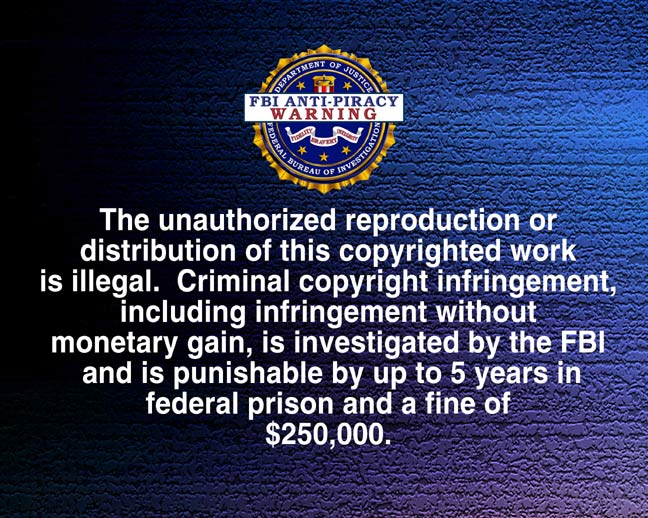
Lately there’s been a lot of gum-flapping about “music piracy”. The RIAA has put out DVD’s containing lavishly-produced infomercials about the evils of file-sharing and the story of The Kid Who Got Caught who now has to spend the rest of his life flipping burgers to pay his legal bills and fines. Each new major-label release comes festooned with a conspicuous FBI Anti-Piracy Warning (on one such release, the performer printed a disclaimer: “The artist does not endorse the message shown below”). Never mind that traditionally it’s the major record labels themselves who routinely take money out of the pockets of musicians. But I digress.

By now, we’re all familiar Apple placing “digital rights management” (DRM) crippleware into music that it sells via Itunes as well as with SONY and their criminal invasion of innocent customers’ computers with malicious “rootkit” software which they said was only meant to - you guessed it - CURB PIRACY. (Whatever happened to “two wrongs don’t make a right”?) It’s a jihad against fair use and even common sense, and we music consumers are THE ENEMY. How did we come to such a state of affairs? What’s going on here?

Back in the early 80's, cassette gear was really getting popular, largely thanks to SONY’s Walkman series of earphone-based portable cassette players, the granddaddies of the Ipod. Back then in those oh-so-analogue days, people would transfer their record collections to tape in order to listen to them on the go. Sometimes they’d tape copies of their albums for their friends which, whether the alkaloid-powder-enhanced record wonks acknowledged it or not, is how many people learned about new bands and different kinds of music. Then as now, commercial radio was too concerned with ratings and advertising to be bothered with breaking new music, at least not without the imprimatur of the major labels. Not to be denied their virtual monopoly power, the record company wonks swung into action. “Home taping is killing music, and it’s illegal!” trumpeted full-page ads in music magazines and on the backs of records, accompanied by a stylized Jolly Roger showing a cassette tape above the traditional crossbones. The record conglomerates attempted, with limited success, to charge customers a “tax” on tape decks and blank tapes, money to be paid directly to the record companies for music which consumers were presumably going to “pirate” using those items.

Skip ahead to the mid-90's. Along comes this kid Shawn Fanning and his new invention, a peer-to-peer file sharing site called Napster. It’s a pay site now, but back then it functioned a lot like Kazaa, Gnutella or Limewire. The major labels rallied their designer-suited troops just as they did in the early 80's. “Piracy! Theft!” the record executives all shouted when pressed on the subject. “Our jobs! Our limos! Our $500.00 lunches!” they whined softly to each other in private. The labels through their cartel, the RIAA, decided that Napster had to be stopped at all costs, and so the litigation began. This despite the fact that while Napster was going full-tilt, CD sales were actually UP - that’s right, up, by 4% as compared to before Napster’s arrival. According to PC Magazine’s John Dvorak, file-sharing services like the old Napster were proving to be excellent promotional vehicles. Peer to peer services also have the advantage of not being governed by the whims of media conglomerates who don’t know enough to get out of their own way (or as a friend once put it, “How come I can download David Bowie’s latest single on Limewire, but I can’t hear it on the radio?”). Before the shutdown of the old Napster, independent bands were actually using it to get their music out to potential audiences. After the shutdown of Napster, CD sales dropped by almost HALF. Was this what the record conglomerates were really shooting for?

To further illustrate my point: Several years ago, a friend shared one of his new CD’s with me. He did it the old-fashioned way, by sending me an audio cassette of it. That tape stayed in my car’s stereo for over a month. It was that good! So I searched out more releases by that group. In all, I bought 5 titles by that band. Net loss to the band - one sale. Net gain to the band - 5 sales. Who came out ahead in that deal? And if my friend had not “pirated” me their first album, I never would have even known that they even existed and never bought ANY of their releases, in which case: net loss to the band - one less fan.

Why do people still use the peer-to-peer networks? Why risk an unwanted visit from The Men In Black Who Know Everything About Everything That You Do? Well, it’s because the paid download sites are essentially virtual mall record stores. Paid download sites, having none of the space limitations common to stores, are free to host many more selections than a real-world store. Just the same, there are hundreds of songs by obscure or forgotten artists which will never be available on the paid sites. There are unreleased recordings which will never see the light of day except via peer-to-peer. While technology has moved by leaps and bounds, the whims of radio programmers, music marketers and focus groups remain just as intractable as ever. As long as things stay this way, there will always be an “underground” music economy.

For the record (also available on cassette and CD), I believe that downloading and sharing commonly-available commercially-released music is a waste of time and bandwidth. I would much rather use the web to explore music that hasn’t been overpromoted and overplayed. There are independent artists who post their music on sites like Garageband.com and Myspace. Unlike the major labels, these bands very much want people to download their music, not because they’re being charitable, but because they know full well that their chances of being played on Clear Channel radio or showing up at a mall chainstore are somewhere between nil and zip. The Web is the only kind of “broadcast exposure” they can hope for. Sure, a lot of them suck, but hey, so does plenty of major-label product, right? You have to “dig” for the good stuff just as you would if you were pawing through a bin full of vinyls or a shelf full of CD’s. The reward is finding music that you didn’t know you couldn’t live without until you found it.

Monday, October 23, 2006

Suppose it were true?


What would happen if America went fascist?

There are those who assert for the millionth time that it couldn’t possibly happen here in the Land Of The Free. Then there are others who say that it has already happened and that the only difference between present-day America and Hitler’s Germany is that the ruling class is wearing designer suits instead of jackboots and armbands.

The parallels between Germany in the mid-1930's and the current New World Order are certainly disquieting to say the least. A leader who was appointed by high government functionaries rather than popular vote, the destruction of a prominent national landmark, in Germany’s case the Reichstag, in ours the World Trade Center, the domination of all branches of government by one party, and finally, the passage of a body of law intended to revoke all civil liberties at the leader’s whim.

Suppose it’s true? Is history repeating itself? Or is something bigger and more frightful in store?

Germany in the 1930's was a powerful, highly-advanced industrial country. Even so, it was minuscule compared to the United States, a typical European state roughly the size of the American state of Wisconsin. Hitler doubtlessly needed allies like Italy’s Mussolini and Spain’s Franco to get his war machine going. The United States is the strongest military power on the planet, with permanent bases on every continent. Alliances can’t hurt, but America is more than capable of going it alone (or going off half-cocked) if it so chooses.

Hitler had primitive versions of what we would now call ballistic missiles, but only conventional warheads for them to carry. America has had nuclear weapons for over 60 years. A fascist dictator in Washington could use the leverage of nuclear terror to get every other nation on the planet to do its bidding. Or he could nonchalantly nuke any nation which he viewed as an obstacle to his plans for world domination, or as a plum target for conquest.

World War II occurred in a world where the primary modes of telecommunication were telephone, telegraph, radio and on rare occasions, television in its infant stages. Business and government records were authored in handwriting or on typewriters. The Internet was a good four decades off. Computers and databases as we now know them did not exist. What the Nazis did have was mechanical devices which sorted punched paper cards (supplied throughout the war to Germany by IBM). They were used by the Nazis to hunt down and round up victims for the death camps and also at the death camps to oil the machineries of genocide. Every Nazi death camp had what we would now call an IT department. With the total information awareness now made possible through electronic information gathering, it’s easier than ever for the state to not only identify its opponents but to attack them without firing a shot or even drawing attention. All you have to do is get a little dirt on your opponents and quietly blackmail them into submission or exploit a little-known medical condition of theirs, or set up a trap based upon your target’s desires, character traits and weaknesses - the possibilities are endless.

Chemical warfare has been around since at least World War I when chlorine, phosgene and “mustard gas” were popular weapons of mass destruction. If Hitler had had the one-whiff-and-you’re-a-stiff nerve agents of the kind recently employed by Saddam Hussein or stockpiled by our own military, it’s safe to say that the outcome of World War II might have been a lot different. Biological warfare in the 1940's had not advanced much beyond the 18th century technique used by English colonists to wipe out native-North Americans by giving them blankets which had been used by smallpox patients. With today’s genetic engineering techniques it is now possible to engineer a so-called “ethnic” pathogen for use against any specific target population.

If America is indeed rocketing down the same path as Hitler’s Germany, the stakes are going to be much, much higher than in World War II. The threat is not only to basic civil liberties, but to the very character of world civilization, if not to human survival itself. There is no longer an opposing superpower to make American leaders think twice about militaristic adventures. In short, if America does come under classic fascism, the threat to ourselves and the world is going to be many orders of magnitude greater than it was even during the darkest days of the second World War in which it appeared as though the Axis powers might win.

Sunday, October 08, 2006

A new dirty war, right here in America.


By now, some of us have heard of The Military Commissions Act of 2006 which President Bush recently signed into law, giving him the right to pretty much kidnap and detain indefinitely anyone who he doesn’t like, without due legal process. Everyone from Federal judges on down has denounced this new law as a great leap backward toward the kind of barbarism we normally associate with Latin-American dictatorships, or fascist Europe during World War II.

I wonder, are These United States really getting ready to emulate Augusto Pinochet’s Chile, or Argentina during the notorious Dirty War of the mid-70's? Are our federal courts so heavily infested with Federalist-Society members and other radical rightists that they actually would uphold what amounts to the wholesale repeal of not only the Bill of Rights, but the rule of law itself? Is it really time to load our muskets or hastily pack a suitcase and get on a plane for anywhere-but-here? Or is there something a little more insidious going on here? Something more mundane and cynical?

Legal challenges to The Military Commissions Act are inevitable. Pro-democracy organizations like the ACLU, People For The American Way and MoveOn.org will certainly mount them, and soon. I have a hard time believing that Congress actually wants to turn America into a Stalinesque terror-state, not to say that it couldn’t happen. But I think the real reason for passing this almost absurdly totalitarian law is to sap the financial and manpower resources of the ACLU, PFAW, etc. for years to come by keeping them busy fighting what I believe will prove to be a patently unconstitutional and unenforceable piece of legislation. What does Congress plan to whip on us while the freedom lobbies are distracted? An end to the 8-hour day and the minimum wage? Heaping content restrictions upon our mass media to the point where innovators and dissenters merely give up rather than face financial ruin? Casting in stone the buying and selling of members of congress like so many pork bellies?